Microsoft Mail Beta is Microsoft's brand new web mail service. The product is being built from the ground up based on input and feedback from customers. Microsoft is inviting people from the MSN Messenger beta to join the beta of their brand new web mail service. Testers will be part of the first group outside of the product team to experience the Mail Beta.
A hotmail account is required and is moved over to the new beta automatically. It includes 2GB of space, includes a rich text editor, protection from "phishing" scams and a new easier layout.
Reading Pane
Cruise through your e-mail with ease, as you go from mail to mail without loading a new page. The Reading Pane lets you preview the text and thumbnails of attached images in your Inbox. Just click the message to display the full content of the e-mail.
Safety made easy with the Info Barback to top
The Info Bar tells you when the Mail Beta doesn't recognize a sender, allowing you to block the sender with a single click, and bounce back an e-mail to help prevent a junk mailer from knowing you exist.
The Mail Beta also protects you from criminals trying to obtain ("phish") your personal information by hiding an e-mail's content when it suspects the sender may be fraudulent.
Address AutoComplete
When you start typing the name of a contact in the address field, Address AutoComplete offers suggestions of matching names from your contact list.
Simply select the correct address—no need to memorize addresses or look through your address book.
Keyboard shortcuts
Mail Beta allows you navigate the way you prefer—via your keyboard, mouse, or a combination of the two.
These keyboard shortcuts let you easily and quickly navigate through messages and folders. Mail Beta also enables multiple select via a combination of your keyboard's arrows or mouse and the shift key.
Many more keyboard shortcuts to come!
Rich text editing
Say what you want to say, the way you want to say it!
Rich Text Editing lets you add color, shading, and emoticons, control font size, and define formatting. Best of all, Mail Beta preserves all HTML formatting in the e-mails you receive so you can forward emails and know others will see them the way you do.
Storage that grows with you
We're starting you with 2GB (2 gigabytes) of storage so you can save more e-mail, more photos, more attachments, more of everything. Over time we plan to develop a system that will grow as you need more space.
(2 gigabytes=2,000,000,000 bytes)
Save sent e-mail
No need to cc: yourself on every outgoing e-mail. All the e-mail you send will now be saved in a "sent e-mail" folder—automatically
Monday, September 05, 2005

Friday, August 05, 2005
The new student chapter started in Bharati Vidyapeeth campus
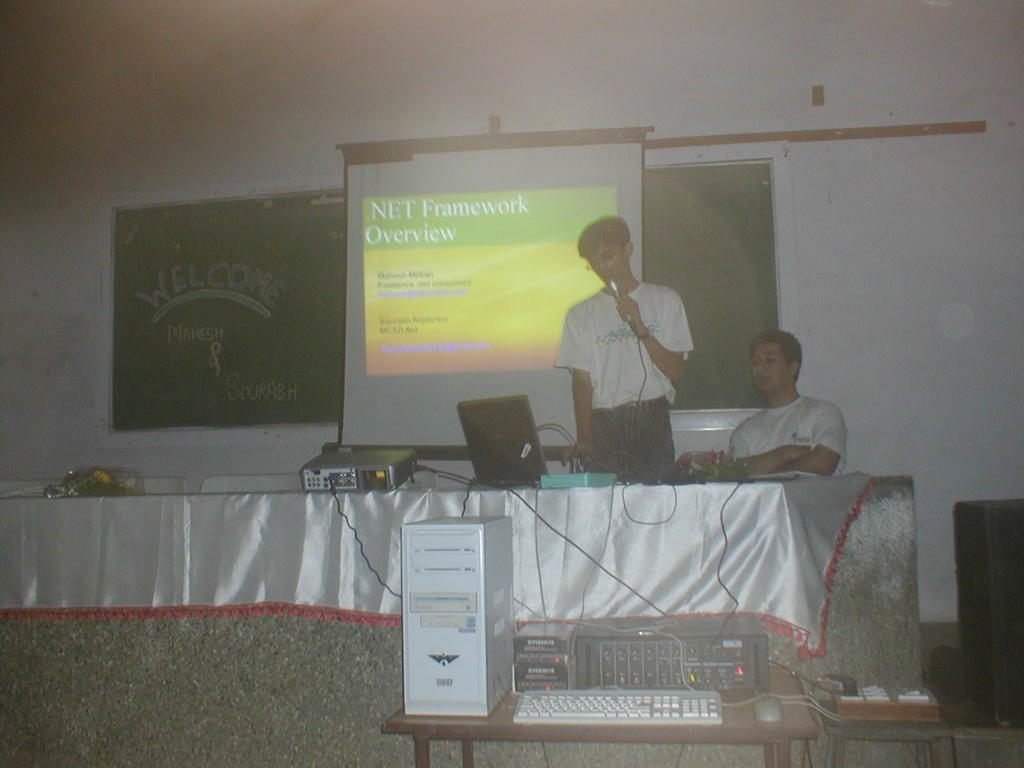
The new student chapter has been started in Bharati Vidyapeeth's Jawaharlal Nehru Institute of Technology, Katraj – Dhankawadi Campus, Pune on 30th July 2005
Mahesh Mitkari and Saurabh (Schamp from MIT)took the introductory session there on Sat 30th July, as” overview of .net framework”
The attendance is about 50+. And total duration of session is about 2 hrs.
Thanks to Mayur and Dev who took the initiative for the session.



Mahesh Mitkari and Saurabh (Schamp from MIT)took the introductory session there on Sat 30th July, as” overview of .net framework”
The attendance is about 50+. And total duration of session is about 2 hrs.
Thanks to Mayur and Dev who took the initiative for the session.


An Overview of SQL Server 2005 - I
An Overview of SQL Server 2005 - I
for the Database Developer
.NET Framework Integration
With the release of Microsoft SQL Server 2005 Beta 2, database programmers can now take full advantage of the Microsoft® .NET Framework class library and modern programming languages to implement functionality within the server. Using common language runtime (CLR) integration, you can code your stored procedures, functions, and triggers in the .NET Framework language of your choice. Microsoft® Visual Basic® .NET and the C# programming language both offer object-oriented constructs, structured exception handling, arrays, namespaces, and classes. In addition, the .NET Framework provides thousands of classes and methods that have extensive built-in capabilities that you can easily use on the server-side. Many tasks that were awkward or difficult to perform in Transact-SQL can be better accomplished by using managed code; additionally, two new types of database objects—aggregates and user-defined types—are available. You can now better use the knowledge and skills that you have already acquired to write in-process code. In short, SQL Server 2005 Beta 2 enables you to extend the database server to more easily perform appropriate computation and operations on the back end.
This integration between SQL Server and the CLR provides several major benefits:
· Enhanced programming model: Programming languages that are compatible with the .NET Framework are in many respects richer than Transact-SQL, offering constructs and capabilities that were previously not available to SQL developers.
· Enhanced safety and security: Managed code runs in a CLR environment, hosted by the database engine. This allows .NET Framework database objects to be safer and more secure than the extended stored procedures available in earlier versions of SQL Server.
· User defined types and aggregates: Two new database objects that expand the storage and querying capabilities of SQL Server are enabled by hosting the CLR.
· Common development environment: Database development is integrated into the Microsoft® Visual Studio® 2005 development environment. You can use the same tools for developing and debugging database objects and scripts that you use to write middle-tier or client-tier .NET Framework components and services.
· Performance and scalability: Because managed code compiles to native code prior to execution, you can achieve significant performance increases in some scenarios.
You can capitalize on the CLR integration to write code that has more complex logic and is more suited for computation tasks, by using languages such as Visual Basic .NET and C#. In addition, Visual Basic .NET and C# offer object-oriented capabilities such as encapsulation, inheritance, and polymorphism. You can now easily organize related code into classes and namespaces, which means you can more easily organize and maintain your code investments when you are working with large amounts of code. This ability to logically and physically organize code into assemblies and namespaces is a huge benefit, and will allow you to better find and relate different pieces of code in a large database implementation.
Managed code is more efficient than Transact-SQL at processing numbers and managing complicated execution logic, and provides extensive support for string handling, regular expressions, and so on. Also, with the functionality that is available in the .NET Framework class library, you now have full access to thousands of pre-built classes and routines that you can access easily from any stored procedure, trigger, or user-defined function. Everything from improved string handling functions, math functions, date operations, access to system resources, advanced encryption algorithms, file access, image processing, and XML data manipulation is easily accessible from managed stored procedures, functions, triggers, and aggregates.
One of the major benefits of managed code is type safety. Before managed code is executed, the CLR performs several checks through a process known as "verification" to ensure that the code is safe to run. For example, the code is checked to ensure that memory is not read that has not been written to.
An Overview of SQL Server 2005 - I
An Overview of SQL Server 2005 - I
for the Database Developer
.NET Framework Integration
With the release of Microsoft SQL Server 2005 Beta 2, database programmers can now take full advantage of the Microsoft® .NET Framework class library and modern programming languages to implement functionality within the server. Using common language runtime (CLR) integration, you can code your stored procedures, functions, and triggers in the .NET Framework language of your choice. Microsoft® Visual Basic® .NET and the C# programming language both offer object-oriented constructs, structured exception handling, arrays, namespaces, and classes. In addition, the .NET Framework provides thousands of classes and methods that have extensive built-in capabilities that you can easily use on the server-side. Many tasks that were awkward or difficult to perform in Transact-SQL can be better accomplished by using managed code; additionally, two new types of database objects—aggregates and user-defined types—are available. You can now better use the knowledge and skills that you have already acquired to write in-process code. In short, SQL Server 2005 Beta 2 enables you to extend the database server to more easily perform appropriate computation and operations on the back end.
This integration between SQL Server and the CLR provides several major benefits:
· Enhanced programming model: Programming languages that are compatible with the .NET Framework are in many respects richer than Transact-SQL, offering constructs and capabilities that were previously not available to SQL developers.
· Enhanced safety and security: Managed code runs in a CLR environment, hosted by the database engine. This allows .NET Framework database objects to be safer and more secure than the extended stored procedures available in earlier versions of SQL Server.
· User defined types and aggregates: Two new database objects that expand the storage and querying capabilities of SQL Server are enabled by hosting the CLR.
· Common development environment: Database development is integrated into the Microsoft® Visual Studio® 2005 development environment. You can use the same tools for developing and debugging database objects and scripts that you use to write middle-tier or client-tier .NET Framework components and services.
· Performance and scalability: Because managed code compiles to native code prior to execution, you can achieve significant performance increases in some scenarios.
You can capitalize on the CLR integration to write code that has more complex logic and is more suited for computation tasks, by using languages such as Visual Basic .NET and C#. In addition, Visual Basic .NET and C# offer object-oriented capabilities such as encapsulation, inheritance, and polymorphism. You can now easily organize related code into classes and namespaces, which means you can more easily organize and maintain your code investments when you are working with large amounts of code. This ability to logically and physically organize code into assemblies and namespaces is a huge benefit, and will allow you to better find and relate different pieces of code in a large database implementation.
Managed code is more efficient than Transact-SQL at processing numbers and managing complicated execution logic, and provides extensive support for string handling, regular expressions, and so on. Also, with the functionality that is available in the .NET Framework class library, you now have full access to thousands of pre-built classes and routines that you can access easily from any stored procedure, trigger, or user-defined function. Everything from improved string handling functions, math functions, date operations, access to system resources, advanced encryption algorithms, file access, image processing, and XML data manipulation is easily accessible from managed stored procedures, functions, triggers, and aggregates.
One of the major benefits of managed code is type safety. Before managed code is executed, the CLR performs several checks through a process known as "verification" to ensure that the code is safe to run. For example, the code is checked to ensure that memory is not read that has not been written to.
_______________________________________
NOTE : This information Published here is ONLY FOR INFORMATIVE PURPOSE of the User Group Members and some part or the full article may be copyrighted or won by the respective owner.
The above Information is either collected from Microsoft website or the various resource kits published by Microsoft or Microsoft partner and this is preliminary information and may be changed substantially prior to final commercial release of the software and cannot guarantee the accuracy of any information Microsoft may have patents, patent applications, trademarks, copyrights, or other intellectual property rights covering subject matter in this document.
Source: Article by Matt Nunn published in a SQL Server 2005 Resource Kit
Also available at http://dotnetvally.blogspot.com
Tuesday, July 05, 2005
Men in Technology
Men in Technology

Yesssssssssssssss !!!!!!!!!!!!!!
finaly Abhishek initiate this idea which come in picture in Tech-Ed 2005 at Mumbai.
hope so we all come with this in Tech-Ed 2006
The community has been initiated and it is live at:
http://www.orkut.com/Community.aspx?cmm=2929700

Yesssssssssssssss !!!!!!!!!!!!!!
finaly Abhishek initiate this idea which come in picture in Tech-Ed 2005 at Mumbai.
hope so we all come with this in Tech-Ed 2006
The community has been initiated and it is live at:
http://www.orkut.com/Community.aspx?cmm=2929700
Subscribe to:
Posts (Atom)